With so many startups popping up left and right, management
styles are also shifting as well. With much smaller companies in such a fast
paced environment, it is crucial for startups to work and innovate quickly in
order to be ahead of the game. In the book The
Lean Startup, Eric Ries tries to tackle this challenge of managing startups
through a lean management technique. Before he gets started, Eric defines the
goal of innovation (or the goal of all startup companies) is “to learn that
which is currently unknown.” With this in mind, entrepreneurs shouldn’t be
thinking, “can something like this be built?” but rather “should it be built?”
Focusing more on lean management, Eric says a team should practice the Build-Measure-Learn Feedback loop.
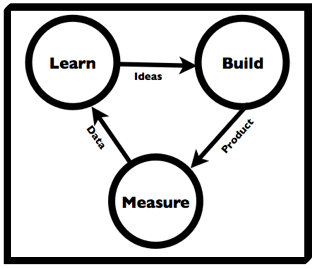
As shown in the figure above, the loop is a cycle where a
team continues to learn from what it builds through measuring its output with
the proper metrics. The key to this cycle is to go through the loop as fast as
possible. Thus, the scope of each of their “build” phase should be small. After
each small release, a team should constantly measure itself, learn from the
metrics, and then use what they learned to focus on what to build next. In
Eric’s words, he states that “the faster they can learn, theoretically, the
faster they can create a sustainable business.”
In order to properly, yet quickly, go through the loop, Eric
focuses on three points. First, the team should employ continuous deployment,
which means that the team should deploy small batches in order to get quicker
feedback. Also, the metrics they use should be actionable. The last point Eric
touches on is that a team should start each loop with a falsifiable hypothesis.
This allows a team to “create predictions for each change that can be proved
correct or incorrect.”
These hypotheses that Eric mentions should eventually grow
into two different types of hypothesis. One, the value hypothesis, asks the
question, “Does the product or service really deliver value?” In order to help
the business become sustainable, the growth hypothesis should also be asked:
“How do new customers discover a product or service?”
Ultimately, Eric encourages this type of loop because it
allows a team to have “learning milestones.” These milestones allow
entrepreneurs to make decisions based on facts discovered through the loops.
However, there will obviously be certain loops where things
don’t go as planned or the metrics show a negative result. In these cases, a
startup should needs to consider a “pivot”. Similar to basketball, a pivot is
“a specific kind of change designed to test a new fundamental hypothesis about
the business, product, and growth.” A team can look into various different
pivots, but Eric mentions a few in his book as Customer Segment Pivot, Customer
Need Pivot, Value Capture Pivot, and Technology Pivot.
Overall, a team’s goal should be to strive for sustainable
growth. In the book, Eric defines “sustainable” as “new customers coming from
the actions of past customers.” This can happen by word of mouth, as a side
effect of product usage (other users are invited by using the product as
designed), or repeated purchase.
Although the book covers a lot more great internal
management techniques and even how to measure engines of growth, the points I
mentioned seemed most relevant to me as I continue to grow my interest in
startups. Even in a corporation, these lean management techniques seem like a
more effective way to run teams and projects. I hope to utilize these methods
as I start my career after college.

No comments:
Post a Comment